
Politics can feel impossible to escape right now.
Headlines on television, political conversations around the dinner table, notifications arriving on our phones, and videos appearing in our children’s social media feeds: even if parents try to shield their children from politics, they’ll still encounter frightening or confusing information at school, online, and through friends.
So how much should you tell your child about what is happening in the world?
Keep in mind that the goal is never to explain everything, or to shield children from everything. Instead, parents can help children develop a sense of safety, context, and agency while allowing their own understanding and beliefs to develop over time.
Children and adolescents don’t experience political information the same way adults do. A young child won’t fully understand the difference between something happening today and a video of something that happened earlier. A teenager may understand current events but encounter an endless stream of emotionally charged information through social media.
And we’re affected too. In the American Psychological Association’s 2024 Stress in America survey, 77% of adults said the future of the nation was a significant source of stress, while 32% said the political climate had caused strain within their families.
That makes one of the most important things parents can do surprisingly simple: help children feel safe enough to think, question, learn, and eventually decide what they believe for themselves.
Why Kids May Feel Overwhelmed by Political News
Children are still developing their understanding of safety, trust, disagreement, facts, emotions, and what they can control.
Political news can make all of these questions feel much bigger. A frightening headline, an argument between adults, or a disturbing video can be interpreted as evidence that the entire world is unsafe.
Children need context that helps them understand difficult events without feeling responsible for solving them.
Young Children Experience News Differently
Young children are still developing their understanding of time. Research by Teresa McCormack and Christoph Hoerl describes significant developmental changes in how children understand temporal concepts and distinguish past, present, and future.
That matters when children encounter repeated news coverage.
An adult may see the same headline several times and think, This is one event. I’m seeing multiple reports about it. A young child may not have the same framework for interpreting what they are seeing.
If your child repeatedly sees images of a disaster, protest, conflict, or other frightening event, provide concrete context about when it happened and what is happening now.
For example:
“This is a video about something that happened earlier. The news is showing it again because people are still talking about it. It isn’t happening again right now.”
That distinction can be reassuring.
How to Talk to Young Children About Politics and the News
Young children don’t need detailed explanations of political parties, legislation, polling, or political strategy. Start with what they actually want to know.
If your child asks, “Why are those people yelling?” answer that question.
If they ask, “Is something bad going to happen to us?” address the fear underneath the question.
A few principles can help:
Keep Explanations Concrete
Use simple, literal language and add complexity as your child gets older.
Separate “Scary” From “Happening Right Now”
Help children understand that repeated coverage does not mean an event is happening repeatedly.
Reassure Without Making Promises You Can’t Keep
Instead of saying, “Everything is going to be fine,” focus on what is true now:
“You are here with me. We are safe right now. The adults in your life are paying attention, and you don’t have to solve this problem.”
Return to Routine
Meals, bedtime, school, play, family rituals, and time with friends can help children experience life as stable even when the larger world feels uncertain.
Talking to Teenagers About Politics
Teenagers are ready for more complexity. They can begin thinking about competing perspectives, misinformation, bias, historical context, evidence, and the difference between an argument and a factual claim.
They are also developing their own identity, values, autonomy, and sense of justice.
Parents can support that development without turning every conversation into a debate.
Try asking:
“What do you think about that?”
“Where did you hear that?”
“What makes you trust that source?”
“Is there another way someone might interpret this?”
“What part of this feels important to you?”
The goal isn’t to win an argument. It’s to help teenagers develop critical-thinking skills while preserving their ability to think for themselves.
Help Teens Understand How Social Media Algorithms Work
For many teenagers, political information appears between videos, memes, comments, messages, and content from friends. Their feed is not a neutral reflection of everything happening in the world.
Recommendation systems use signals such as what someone watches, likes, shares, skips, or searches for to help determine what content they may continue seeing.
Recent research by Leonhard, Wendt, and Riesmeyer on adolescent algorithm literacy found connections between teens’ understanding of the algorithmic systems and how they interact with social media content, including behaviors such as blocking content and adjusting privacy settings.
This can become a conversation rather than another lecture about screen time.
Instead of saying, “TikTok is filling your head with garbage,” try:
“Have you ever noticed that once you watch a certain kind of video, you suddenly get a lot more of them?”
Help your teenager understand that seeing something repeatedly doesn’t automatically make it more true, more important, or more representative of reality.
Turn Their Sense of Justice Into Agency
Teenagers often care deeply about fairness and justice. Rather than dismissing that intensity, parents can help them use it constructively.
Ask:
“What about this matters to you?”
“What do you wish were different?”
“What can you actually influence?”
Young people can care deeply about the world without carrying the entire world on their shoulders. They might volunteer, learn more about an issue, participate in a community project, create something, help someone locally, or simply become better informed.
The goal isn’t to direct a teenager toward a particular political position. It’s to help them recognize that caring about something doesn’t require allowing it to consume them.
Teach The Pause Before The Reaction
Political content can be emotionally activating at any age.
A frightening headline might make a child want to keep scrolling. An angry video might make a teenager want to react immediately. A shocking claim may feel urgent simply because it is emotionally intense.
We all need to pause and ask:
What actually happened?
When did it happen?
Who is reporting it?
Is this a fact, opinion, or prediction?
Can I find another reliable source?
Am I learning something, or am I becoming more upset?
Do I need to keep consuming this right now?
These are media-literacy skills, but they can also help young people recognize when they are becoming overwhelmed. And parents can model this!
Parents Have Nervous Systems, Too
Parents are absorbing the same political environment as their children. You may be worried, angry, frightened, or tempted to constantly check for the latest update.
This is so understandable.
Children look to caregivers for cues. Is the world a safe place? You don’t have to hide your emotions, but you can model what healthy regulation looks like.
You might say:
“I’m feeling worried about what I’m seeing in the news, so I’m going to take a break from my phone and go for a walk.”
Your child doesn’t need a perfectly calm parent. They need a parent who can notice when they are activated and practice returning to steadiness.
Create a Family Media Environment That Feels Safe
You don’t necessarily need to ban news or politics. Instead, consider setting boundaries around when and how your family consumes it.
Some good guidelines:
- Keep news off during certain family routines
- Avoid graphic footage around young children
- Create screen-free time before bed
- Encourage breaks after emotionally intense content
- Talk about what your child is seeing
- Help teenagers identify trustworthy sources
- Make room for activities unrelated to current events
Most importantly, let home remain a place where your child can still be a child.
There should be room for school, friends, hobbies, family meals, jokes, play, boredom, and ordinary life. The world can be complicated without every moment of childhood becoming a commentary on that complexity.
Meet Jennifer Prior and Estelle Gyimah
Wolcott Counseling & Wellness is excited to welcome Jennifer Prior, RMHCI, and Estelle Gyimah, RMHCI, to the team, expanding our ability to provide therapy for children, adolescents, families, and individuals.
Jennifer’s professional focus includes child and adolescent mental health. She specializes in Person-Centered Therapy, Trauma-Focused Cognitive Behavioral Therapy (TF-CBT), and Play Therapy. Her experience includes supporting children and families involved with law enforcement, the Department of Children and Families, the court system, and the Child Advocacy Center.
Estelle works with children, teens and adults and has a particular interest in grief and loss, trauma, relationships, anxiety, depression, financial stress, and undiagnosed or untreated mental illness. She has expertise in working with individuals who are in crisis. She specializes in Humanistic, Person-Centered therapy and has experience in hospital and community settings, including crisis intervention through the Alachua County Crisis Center.
Both therapists recognize that children don’t always have the words to explain what they are experiencing. Sometimes children communicate through play, behavior, relationships, or changes in everyday life.
When Your Child Needs a Safe Place to Process
For some children, political tension may be one of many things contributing to an overloaded nervous system. For others, current events may activate previous experiences of trauma, loss, instability, family conflict, or fear.
A trauma-informed approach begins with safety and curiosity rather than assuming a child’s reaction is irrational or excessive.
Instead of asking your child, “Why are you reacting this way?” you might ask yourself, “What might my child’s nervous system be responding to?”
At Wolcott Counseling & Wellness, our therapists provide strengths-based, trauma-informed care that considers each child’s and family’s history, needs, and existing resources.
A Word About Trauma, Safety and Privilege
Not everyone lives with the same time and space for reflection that these conversations demand. We recognize that to have calm, regulating, inquisitive conversations is a privilege belonging to fortunate circumstances.
Remember Maslow’s Hierarchy of Needs? Our physiological needs (food, shelter, sleep, air) must be met before we can address safety needs, and safety (predictability, financial security, freedom from physical danger, and health) comes before everything else we’re talking about here.
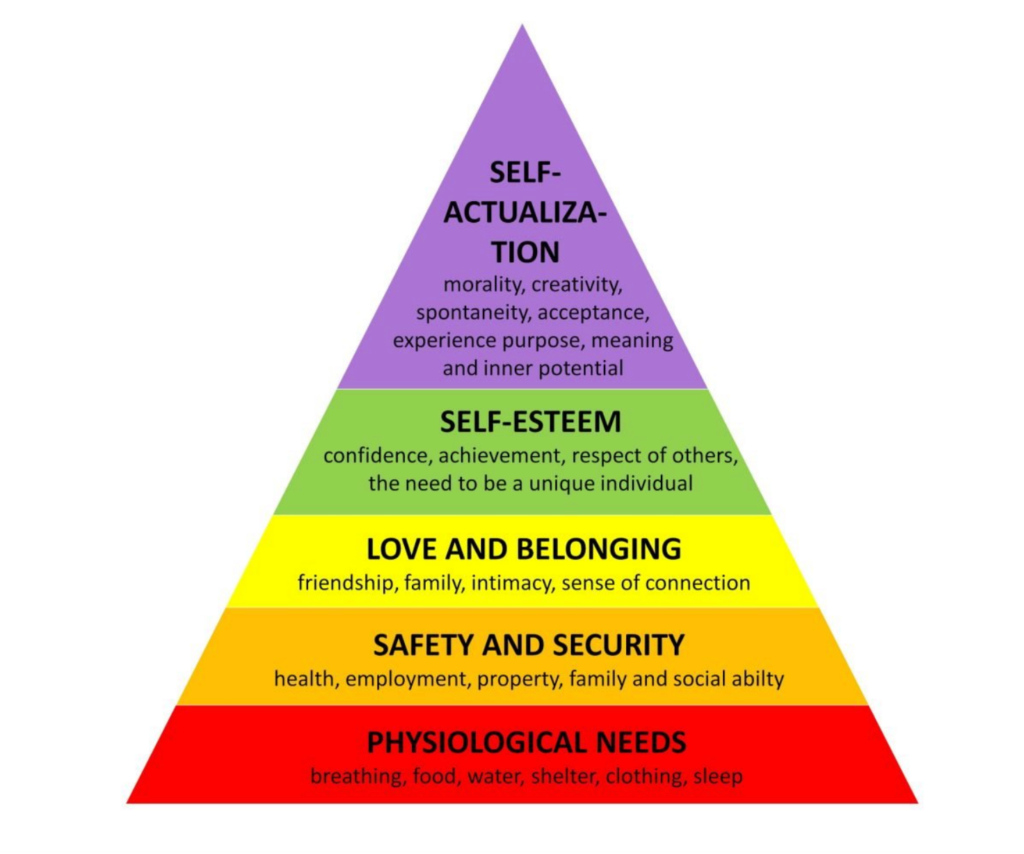
And we know that far too many children grow up in high-stress, oppressive, or highly volatile environments – whether due to poverty, crime, racism, misogyny, domestic violence, or parents with emotional or personality disorders.
Part of our work – all of us – is to work towards a world where our children’s physiological and safety needs are met as a matter of course. All children deserve to grow and develop with parents who can meet all their basic needs, have time and space to learn about child development, and co-exist with them in a state of emotional regulation. We must also understand that it’s unlikely their emotional and psychological needs will be met without this.
At Wolcott Counseling & Wellness, we’re always in conversation about both personal and societal trauma, and we work with our clients holding this broader understanding of context in mind. We have a “person-in-their-environment” perspective (we don’t exist in a vacuum!), and we work with our clients to encourage them to understand the forces of injustice and oppression that affect their own lives, alongside their responsibility to respond and grow within this and other truths.
This is how we have real conversations about healing and personal growth. And we believe that everyone deserves the space to have calm, regulating conversations and room to explore their lives. That’s what therapy with us is all about.
Therapy for Children and Adolescents in Gainesville
If your child or teenager struggles with anxiety, fear, trauma, or the emotional weight of what they are seeing in the world, please don’t navigate this alone.
Wolcott Counseling & Wellness offers trauma-informed, inclusive counseling in Gainesville for children, adolescents, families, and individuals, with in-person and secure telehealth therapy options available for eligible clients. Jennifer Prior and Estelle Gyimah are currently accepting clients.
Contact us today to learn more about available appointments and whether therapy may be a good fit for your child.
Raising children in our world today is hard, hopeful work. Thank you for doing it. You deserve support and understanding too! Take care of yourself, and if you need some support, or just a place to process this hard work, we are here for you.
References
American Psychological Association. (2024, October 22). APA poll: Future of nation, economy and presidential election top U.S. stressors. https://www.apa.org/news/press/releases/2024/10/top-us-stressors
Children’s Health. (n.d.). Talking to kids about politics. https://www.childrens.com/health-wellness/talking-to-kids-about-politics
Leonhard, L., Wendt, R., & Riesmeyer, C. (2026). Being literate, behaving literate? A mixed-methods approach to adolescents’ algorithm literacy and behavioral strategies on social media. New Media & Society. Advance online publication. https://doi.org/10.1177/14614448261446589
McCormack, T., & Hoerl, C. (2017). The development of temporal concepts: Learning to locate events in time. Timing & Time Perception, 5(3–4), 297–327. https://doi.org/10.1163/22134468-00002094